Printable Music Staff Paper
Free PDF downloads of blank manuscript paper: five-line staves with no clefs or bar lines, 11 staves on US Letter and 12 on A4.
Free download
Vector PDF — prints crisp at any resolution. No sign-up, no watermark.
More versions to print
The same music staff paper in other paper sizes and line colors, each a free vector PDF. Light gray lines fade into the background so your writing stands out; dark gray ones stay clear on photocopies and on printers low on ink.
Light blue lines · A4Download PDFEdit 
Light gray lines · US LetterDownload PDFEdit 
Light gray lines · A4Download PDFEdit 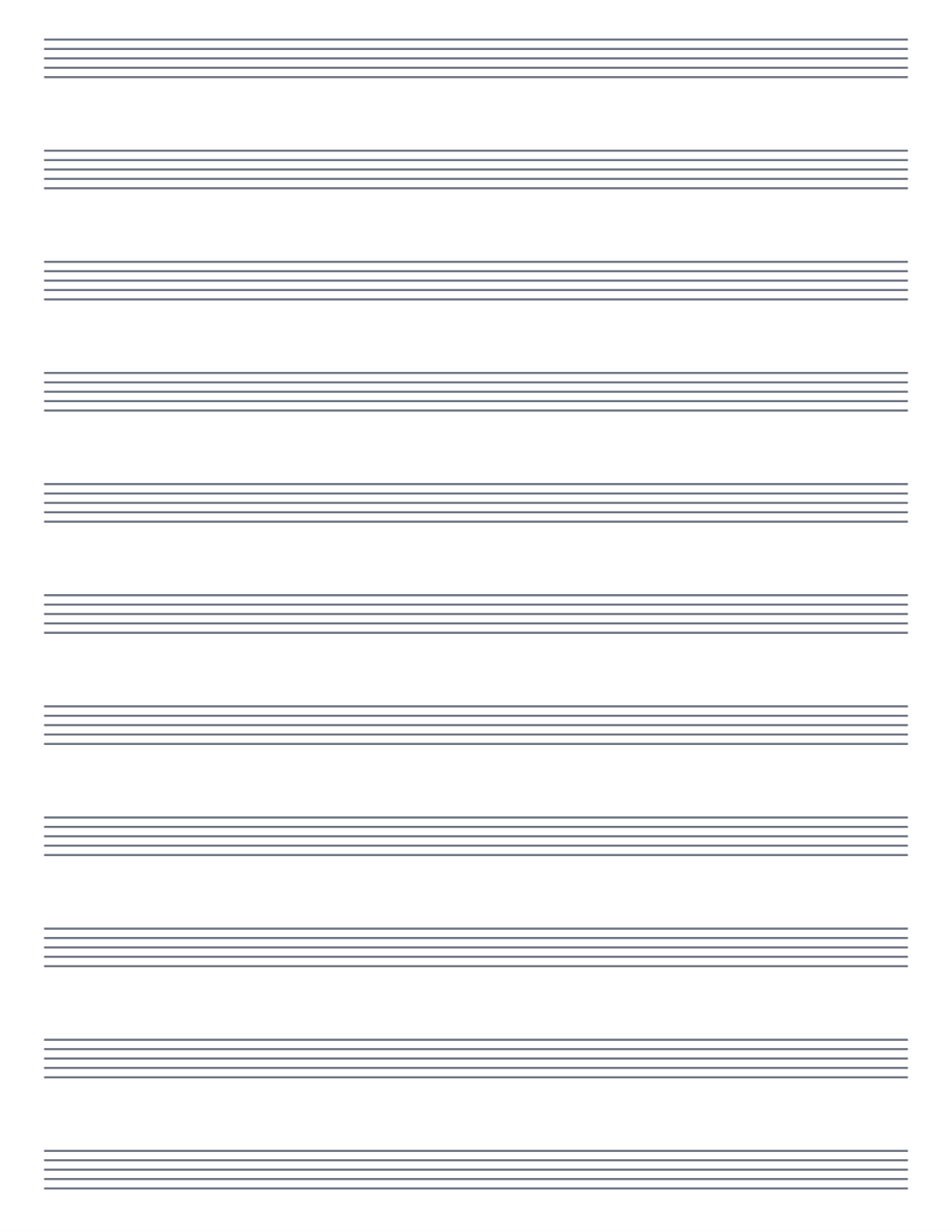
Dark gray lines · US LetterDownload PDFEdit 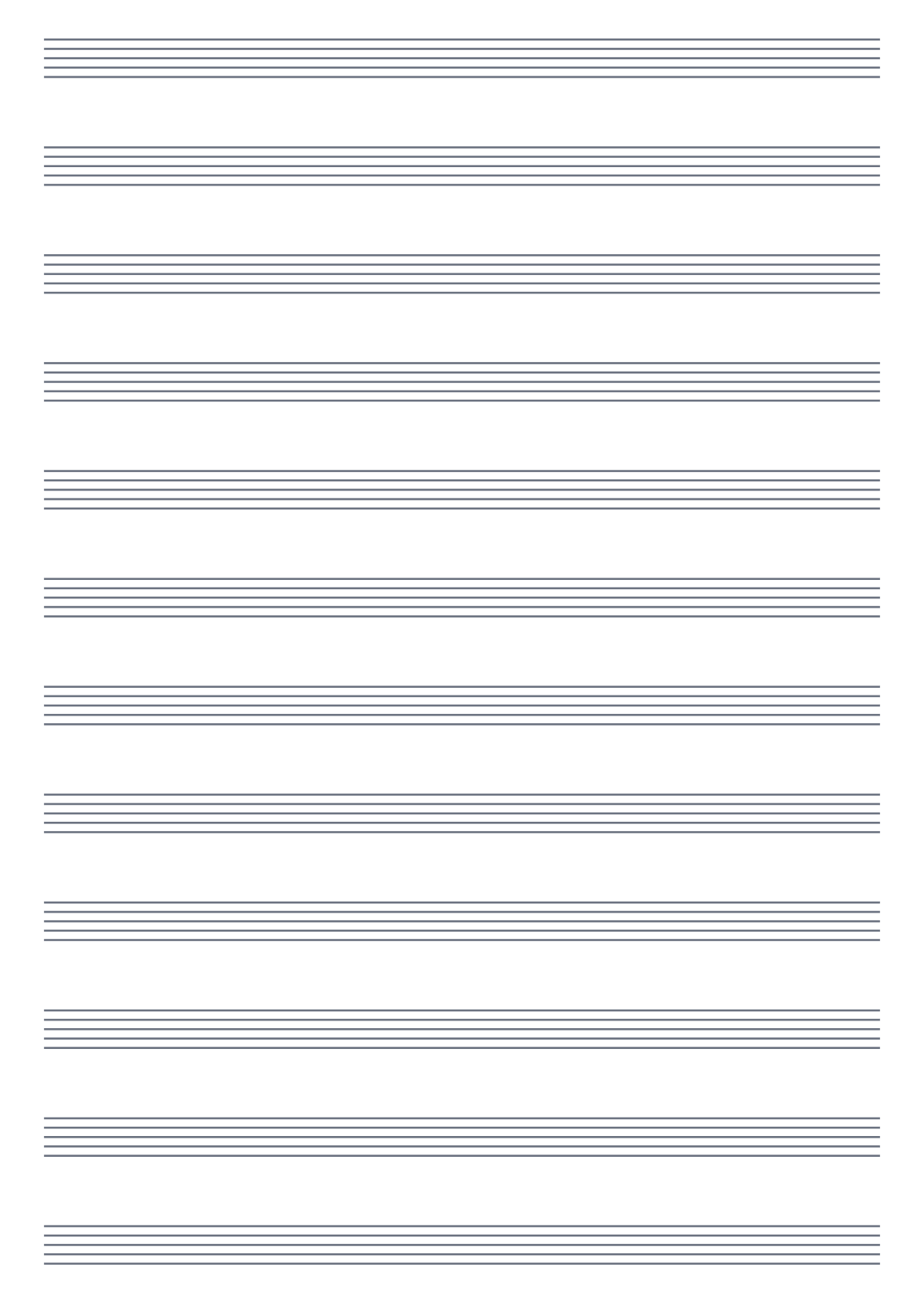
Dark gray lines · A4Download PDFEdit
Staff size and layout
Each staff has five lines with about 2.1 mm between them, so a staff is about 8.5 mm (1/3 inch) tall. That is a common size for handwritten music: large enough for clear note heads, small enough to fit a full page of music. The staves stop 10 mm from the left and right edges of the paper and are spread evenly down the page.
The staves are blank, with no clefs, key signatures or bar lines. You can use the same sheet for treble, bass, alto or percussion parts and draw bar lines where your music needs them.
Specifications
| US Letter PDF | A4 PDF | |
|---|---|---|
| Staves per page | 11 | 12 |
| Lines per staff | 5 lines, 4 spaces | 5 lines, 4 spaces |
| Space between staff lines | About 2.1 mm | About 2.1 mm |
| Staff height | About 8.5 mm (1/3 in) | About 8.5 mm (1/3 in) |
| Gap between staves | About 17 mm | About 16 mm |
| Side margins | 10 mm | 10 mm |
| Clefs and bar lines | None | None |
| Line color and file | Light blue, vector PDF | Light blue, vector PDF |
Anatomy of a staff
A staff has five lines and four spaces, counted from the bottom up. In treble clef the lines are E, G, B, D, F and the spaces F, A, C, E; in bass clef the lines are G, B, D, F, A and the spaces A, C, E, G. Notes above or below the staff use short ledger lines, which you draw yourself.
The gap between staves on this paper is about twice the height of a staff. That leaves room for two or three ledger lines, chord symbols above the staff, or a line of lyrics below it.
Single staff, grand staff or guitar TAB
The printable sheets are single staves. The editor adds two other layouts:
| Layout | What it is | Use it for | Where |
|---|---|---|---|
| Single staff | One five-line staff per system | Melodies, single instruments, voice parts, theory exercises | These PDFs, or the editor with a treble or bass clef |
| Grand staff | A treble and a bass staff joined by a brace | Piano and keyboard music, harmony and part writing | Editor |
| Guitar TAB | Six lines, one per string, with fret numbers instead of notes | Riffs, fingerstyle arrangements, chord shapes | Editor |
Who uses blank staff paper
- Songwriters sketching a melody and its chord changes before recording it.
- College music students working on theory assignments, part writing and melodic dictation.
- Arrangers writing out individual parts for a band or choir.
- Players transcribing a solo by ear, a few bars at a time.
- Choir and ensemble members copying out a harmony line they need to learn.
Tips for writing music by hand
Use a pencil, such as an HB or a 0.5 mm mechanical pencil, so you can erase wrong notes cleanly. Ink is best kept for the final copy.
Make each note head fill one space, about 2 mm tall on this paper, slightly oval and tilted. Stems run about an octave long (three and a half spaces): up on the right side of the note head for notes below the middle line, down on the left side for notes on or above it.
Plan bars before you write. Count the beats in the phrase, then divide each staff into equal bars in pencil; four bars per staff is a comfortable default at this size, and two or three suit busy passages. Write the clef, key signature and time signature on the first staff, and repeat the clef and key signature at the start of each new staff.
Grand staff, TAB and clefs in the editor
Open the template in the free editor for more layouts: treble or bass clef staves, grand staff for piano, or six-line guitar TAB. You can choose 6 to 12 staves per page, add 2 to 4 bars per staff, and place notes, rests, accidentals and time signatures on the staves. Print the result or download it as a PDF.
Frequently asked questions
What is blank music paper called?
It is called staff paper, manuscript paper, or music writing paper. A staff (stave in British English) is the set of five lines that notes sit on.
How many staves are on a page?
These templates have 11 staves on US Letter and 12 on A4. In the editor you can set 6, 8, 10 or 12 staves per page; fewer staves give each one more space.
Why are there no clefs on the printed sheets?
So the same sheet works for any instrument or voice. Write the clef you need at the start of each staff, or open the editor to print staves with a treble or bass clef already drawn.
Can I get staff paper with a treble and bass clef?
Yes. In the editor, choose the grand staff layout for paired treble and bass staves, or a single staff with a treble or bass clef, then print it or download a PDF.
Can I write lyrics on staff paper?
Yes. The gap between staves, about 16 to 17 mm, leaves room for a line of lyrics under each staff. In the online editor, text you type on staff paper goes into that gap, starting after the clef.