How to Write Music on Staff Paper
Handwritten music is easy to read when every staff starts the same way, every bar adds up, and every note follows a few drawing rules. This guide covers them in the order you write them.
Quick answer
Start each staff with a clef and the key signature; add the time signature on the first staff only. Divide the staff into bars in pencil, then write the notes: heads that fill one space, stems about 3½ spaces long, up on the right for notes below the middle line and down on the left for notes above it. Check that the beats in every bar add up to the time signature.
What you need
- Blank staff paper. The music staff paper on this site has 11 staves on US Letter and 12 on A4, with about 2.1mm between the lines.
- A pencil, such as an HB or a 0.5mm mechanical pencil, and a good eraser. Wrong notes are part of writing music.
- A short ruler for bar lines and beams. Freehand bar lines lean after a few staves.
Know the staff
A staff has five lines and four spaces, always counted from the bottom up. The clef decides which note each line stands for. Notes above or below the staff sit on short extra lines, called ledger lines, which you draw yourself.
| Treble clef | Bass clef | |
|---|---|---|
| Where it sits | The curl wraps around the second line, which becomes G | The two dots sit either side of the fourth line, which becomes F |
| Lines, bottom to top | E, G, B, D, F | G, B, D, F, A |
| Spaces, bottom to top | F, A, C, E | A, C, E, G |
| Middle C | On one ledger line below the staff | On one ledger line above the staff |
| Used for | Voice, violin, flute, guitar, the right hand on piano | Cello, bass guitar, low voices, the left hand on piano |
Write the start of each staff
- Clef. Draw it at the very start of the staff, on every staff of the piece.
- Key signature. Right after the clef, write the sharps or flats of the key, on every staff. Sharps always appear in the order F, C, G, D, A, E, B, and flats in the order B, E, A, D, G, C, F. A key with two sharps has F♯ and C♯, never any other pair.
- Time signature. After the key signature, on the first staff only. The top number is the number of beats in a bar; the bottom number is the note that gets one beat, where 4 means a quarter note and 8 an eighth note. 4/4 has four quarter-note beats per bar, 3/4 has three, and 6/8 has six eighth notes, felt as two groups of three.
Plan the bars before the notes
Count the bars in the phrase, then divide each staff into equal parts in light pencil. On staff paper of this size, four bars per staff is a comfortable default; use two or three for bars full of short notes. A bar line is a thin vertical line from the top line of the staff to the bottom one. End the piece with a double bar: a thin line followed by a thick one.
Note values
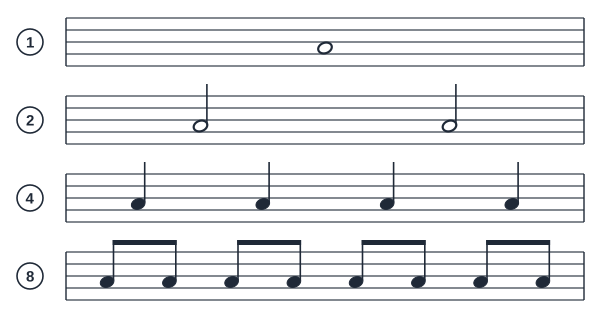
The shape of a note shows how long it lasts. In 4/4 time the values below fill a bar in these amounts:
| Note | How to draw it | Beats in 4/4 | Rest of the same length |
|---|---|---|---|
| Whole note | An open oval, no stem | 4 | A small block hanging below the fourth line |
| Half note | An open oval with a stem | 2 | A small block sitting on the middle line |
| Quarter note | A filled oval with a stem | 1 | A vertical zigzag |
| Eighth note | A filled oval, stem and one flag | ½ | A slanted stroke with one hook, like a 7 |
| Sixteenth note | A filled oval, stem and two flags | ¼ | The same stroke with two hooks |
A dot after a note adds half of its value: a dotted half note lasts 3 beats, a dotted quarter note 1½. Two notes of the same pitch joined by a curved tie are played as one long note, which lets a sound continue across a bar line.
Draw notes that are easy to read
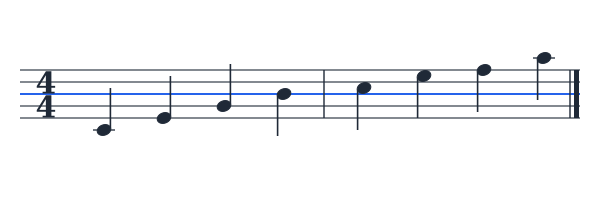
- Note heads. Make each head fill one space, slightly oval and tilted up to the right. A note on a line has the line through its middle; a note in a space touches the lines above and below.
- Stems. About 3½ spaces long, the distance of an octave. Notes below the middle line take a stem going up from the right side of the head; notes above it take a stem going down from the left side. Notes on the middle line usually point down.
- Flags. Always on the right side of the stem, whichever way the stem points.
- Beams. Replace the flags of eighth and sixteenth notes that fall in the same beat with a straight beam. In 4/4, beam eighth notes in pairs, or in fours across beats 1 and 2 or beats 3 and 4, but not across the middle of the bar.
- Ledger lines. Space them like the staff lines and keep them only a little wider than the note head. Do not join the ledger lines of neighboring notes.
- Accidentals. A sharp, flat or natural goes just before the note head, on the same line or space. It lasts until the end of the bar.
Space the notes in a bar
Give longer notes more room than shorter ones, but not in strict proportion: a half note needs a little more space than a quarter note, not twice as much. Leave a small gap after each bar line before the first note. On a grand staff for piano, line up notes that sound together vertically, so the treble and bass staves can be read as one.
Check every bar
Before you ink anything, count each bar. The note and rest values must add up to the time signature: four quarter-note beats in 4/4, three in 3/4. A bar that is one eighth note short is the most common error in handwritten music, and it is much easier to fix in pencil.
Common mistakes
- Stems on the wrong side. An up stem belongs on the right of the head, a down stem on the left.
- Note heads that cover two spaces. A head that is too large sits between two pitches and cannot be read.
- Forgetting the clef and key on later staves. Every staff needs both; only the time signature is written once.
- Beaming across the middle of a 4/4 bar. It hides where beat 3 begins.
- Accidentals after the note. They always go in front of the note head.
Where to go next
Print a few sheets of staff paper and copy out a short melody you already know, checking each rule above as you go. In the generator you can switch the staves to a treble or bass clef, a grand staff for piano or six-line guitar TAB, and choose 6 to 12 staves per page. For chord charts and lyrics next to the music, keep a sheet of lined paper alongside.
Frequently asked questions
Which way do note stems go?
For notes below the middle line of the staff, the stem goes up from the right side of the note head. For notes above it, the stem goes down from the left side. Notes on the middle line usually take a down stem.
Do I need to write the clef on every staff?
Yes. The clef and the key signature start every staff. The time signature is written only at the beginning, and again only where it changes.
How many bars should I put on one staff?
Four is a good default on standard staff paper. Use two or three when a bar holds many eighth or sixteenth notes, and up to six for slow music with long notes.
How long should a note stem be?
About three and a half spaces, the height of an octave. On staff paper with 2.1mm between the lines, that is roughly 7 to 8mm.
Should I write music in pen or pencil?
Pencil for the draft, so you can erase wrong notes and adjust spacing. Use a fine pen only for a final copy that others will read.