Monthly Habit Tracker on Dot Grid Paper
A habit tracker is a grid with one square for each habit on each day. On dot grid paper the dots already give you the squares, so a month takes a ruler, a fine pen and about ten minutes to draw.
Quick answer
Number the days 1 to 31 across the top, one square each, and give every habit one row. On A4 dot grid with dots 5mm apart, 31 days take 155mm, and 8 squares (40mm) are left on the left for the habit names. Fill in a square on each day you did the habit, and at the end of the month count the filled squares in each row.
What you need
- Dot grid paper. The dot grid paper on this site has dots 5mm apart: 42 dots across and 60 down on A4, and 44 across and 56 down on US Letter.
- A fine pen, 0.3 to 0.5mm, for the grid lines, and a ruler to keep them straight.
- A highlighter or colored pens if you want to tell habits apart. A pencil works too.
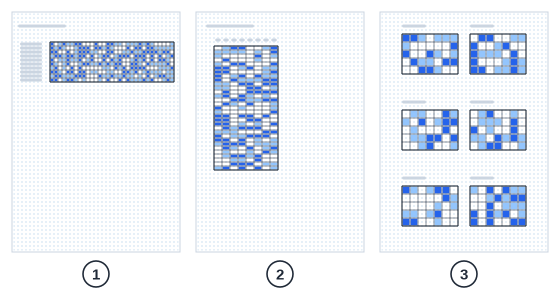
Layout 1: days across, habits down
This is the classic tracker, and the easiest to read at a glance: each row shows one habit for the whole month.
- Write the month at the top, two or three rows below the first line of dots.
- Leave 8 squares on the left for the habit names, then number the next 31 squares for the days. On A4 this uses 39 of the 41 squares between the first and last dot, so one square is left at each edge. On US Letter there are 43 squares, so you can give the names 10.
- Draw one row per habit, one square tall. Eight to twelve habits fit comfortably on half a page; for fewer habits, make each row two squares tall.
- Draw the outer frame first, then the column lines every square, then the row lines.
Layout 2: days down, habits across
Turn the grid around when you track many habits or want to add a short note for each day. Number the days down the left side, one square per day: 31 days take 155mm of height, about half an A4 page. Give each habit a column two squares wide, with its name written at the top, sideways if needed. After a 2-square date column, an A4 sheet has room for about 18 such columns. The empty space to the right of the grid, or below it, is room for a one-line comment each day.
Layout 3: one small calendar per habit
For three to six habits, draw a small month calendar for each one: 7 columns for the days of the week and 5 or 6 rows for the weeks, with each day a block of 2 × 2 squares. Each calendar is then 14 squares wide and at most 12 tall, so two fit side by side on A4 or US Letter, and three rows of calendars fill most of the page. This layout shows weekly patterns well, for example a habit that always slips on weekends.
Choosing habits to track
- Keep it short. Three to eight habits are easy to check every evening; twenty become a chore.
- Make each habit a yes or a no. “Walk 20 minutes” or “read 10 pages” can be ticked; “be healthier” cannot.
- Mark the days a habit doesn’t apply. For something you plan three times a week, such as a gym session, put a small dash in the days you don’t plan it, so the empty squares really are misses.
- Track a new habit for a full month before you judge it. A few blank days early on are normal.
Marking the squares
Fill the square when you did the habit, and leave it blank when you didn’t. If you want more detail, fill half the square for “partly done” and put a dot in it for “skipped on purpose”, such as a rest day. Use one color per habit, or one color for everything; what matters is that you fill the tracker at the same time each day, for example before bed. In months with 28, 29 or 30 days, cross out the extra columns when you draw the grid.
Review the month
On the last day, count the filled squares in each row and write the total at the end. Divide by the number of days that counted, and multiply by 100 for a percentage: a habit done on 22 of 30 days scores 73%. Compare the rows, drop or change the habits that never stuck, and carry the rest over to next month’s page.
Common mistakes
- Drawing a whole year in advance. Habits change; draw each month at its start.
- Squares that are too small to fill. Stick to one dot square (5mm) per day or larger.
- Tracking outcomes instead of actions. “Lose weight” isn’t something you do on a given day; “cook dinner at home” is.
- Filling it in from memory a week later. The tracker only works if it is filled the same day.
Where to go next
Print a few sheets of dot grid paper and draw this month’s tracker today. If you also plan your week on paper, the weekly planner layouts guide shows how to lay out a week on the same grid, including a weekly version of this tracker. In the generator you can change the dot spacing and color before printing.
Frequently asked questions
How many habits should I track?
Three to eight is a good range. That is few enough to check every evening and enough to see patterns. Add more once the first ones have become routine.
Does a monthly habit tracker fit on one page?
Yes. On A4 dot grid with 5mm dots, 31 day columns take 155mm and leave 8 squares for the habit names, and a row per habit takes 5mm. Even 15 habits use only about a third of the page.
Is a monthly or a weekly habit tracker better?
A monthly tracker shows streaks and gaps at a glance and only needs drawing twelve times a year. A weekly tracker fits next to a weekly plan and makes it easier to change habits often.
What should I do when I miss a day?
Leave the square empty and carry on the next day. The tracker is a record, not a test: a row with a few gaps still shows the habit is mostly there.
What dot spacing is best for a habit tracker?
5mm, the standard dot spacing, gives squares big enough to fill with a highlighter and still fits 31 days across the page. With 7mm or more between the dots, 31 days no longer fit across an A4 page in one row.