Printable Hexagonal Paper
Free PDF download of hexagonal graph paper (hex grid paper) with 1/2 inch or 1 inch hexagons, on US Letter or A4: for organic chemistry structures, tabletop game maps and honeycomb patterns.
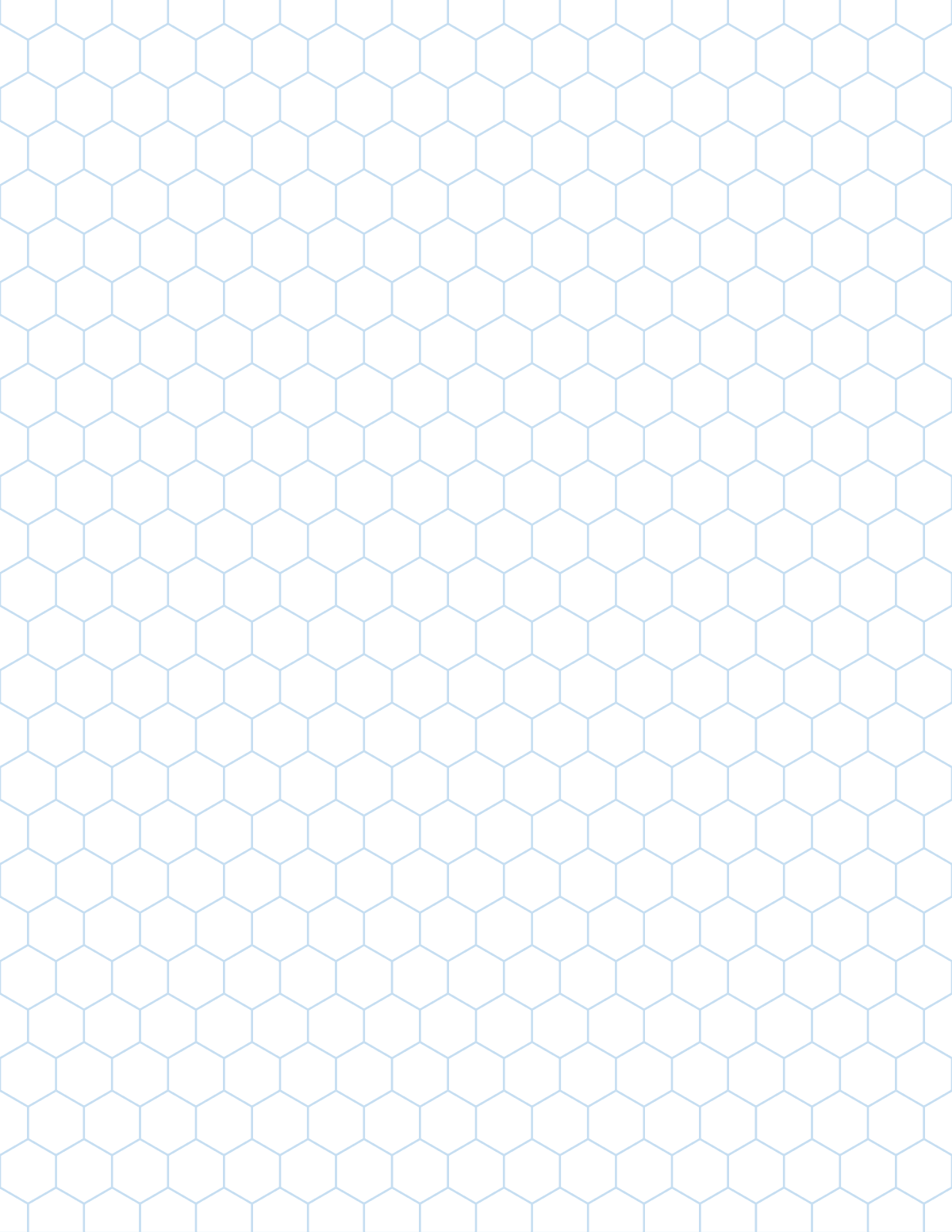
Free download
Vector PDF — prints crisp at any resolution. No sign-up, no watermark.
More versions to print
The same hexagonal paper in other paper sizes and line colors, each a free vector PDF. Light gray lines fade into the background so your writing stands out; dark gray ones stay clear on photocopies and on printers low on ink.
Light blue lines · A4Download PDFEdit 
Light gray lines · US LetterDownload PDFEdit 
Light gray lines · A4Download PDFEdit 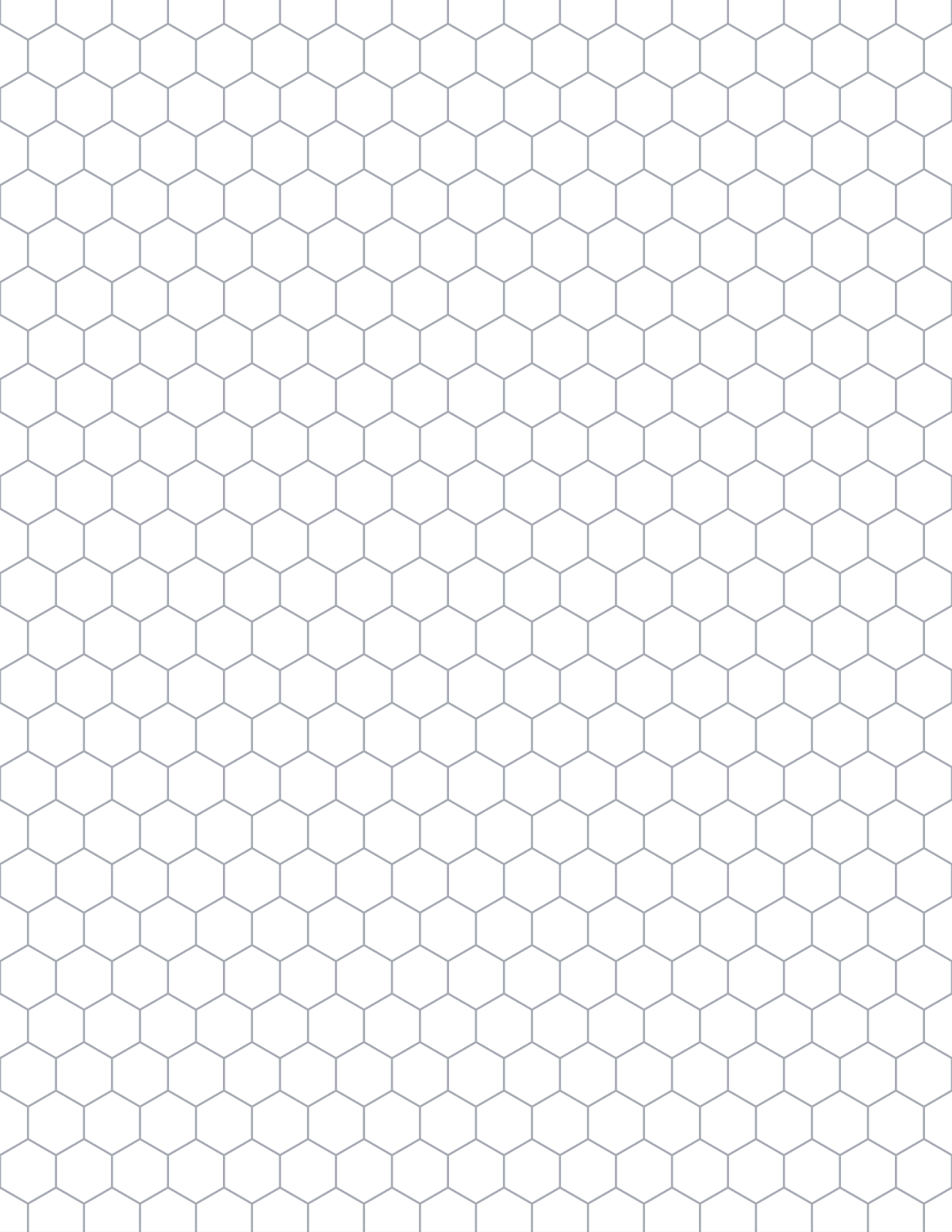
Dark gray lines · US LetterDownload PDFEdit 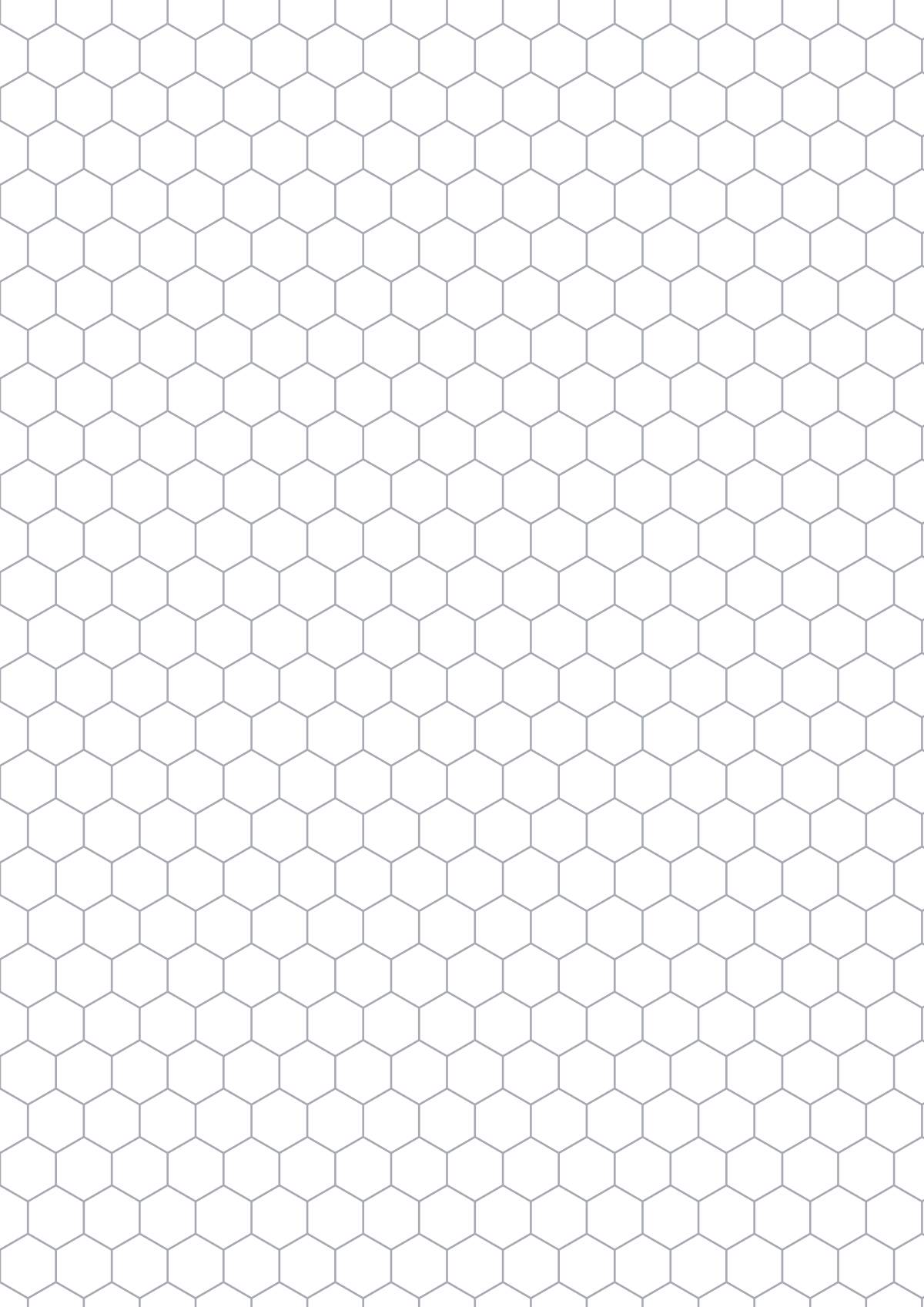
Dark gray lines · A4Download PDFEdit
What is hexagonal paper?
Hexagonal paper, also called hex paper or hex grid paper, is covered with regular hexagons that fit together like a honeycomb, with no gaps between them. Every hexagon touches six neighbors, and the center of each neighbor is the same distance away.
That even spacing is what a square grid cannot offer. On graph paper, a diagonal neighbor is about 41% farther away than a side neighbor. On a hex grid, a step in any of the six directions covers the same distance, which is why hexagons are used for maps and for anything that spreads evenly in all directions.
Specifications
The size of a hexagon is measured across its flat sides, the way game maps and most hex paper are labeled. The hexagons stand on a point ("pointy top"), and the grid runs to the edge of the sheet.
| 1/2 inch hexagons | 1 inch hexagons | |
|---|---|---|
| Width across the flat sides | 1/2 in (12.7mm) | 1 in (25.4mm) |
| Length of each side | 7.3mm (about 0.29 in) | 14.7mm (about 0.58 in) |
| Height from point to point | 14.7mm (about 0.58 in) | 29.3mm (about 1.15 in) |
| Hexagons across a US Letter page | 17 | 8 1/2 |
| Rows on a US Letter page | About 25 | About 12 |
| Line color | Light blue, fine 0.26mm lines | Light blue, fine 0.26mm lines |
| File | Vector PDF, one page (US Letter or A4) | Vector PDF, one page (US Letter or A4) |
Hexagonal paper for organic chemistry
In skeletal formulas, a six-membered carbon ring such as benzene or cyclohexane is drawn as a regular hexagon, and chains are drawn as zigzags with angles of about 120°. Those are exactly the shapes and angles a hex grid gives you. Tracing along the printed lines keeps rings the same size, bonds the same length and fused rings such as naphthalene properly lined up.
The 1/2 inch sheet suits most coursework: its 7.3mm sides are long enough to add a double bond inside a ring and to write a substituent such as OH or CH₃ at a corner. Draw the structure in pen and leave the grid in the background, or print the light gray version if you plan to photocopy or scan your work.
Hex grid paper for tabletop games and maps
Role-playing games, wargames and board game prototypes use hex maps because movement costs the same in every direction, and distances can be counted in hexes without measuring.
- Battle maps: the 1 inch sheet fits standard 25mm (1 inch) miniature bases, one figure per hexagon.
- Regional and world maps: the 1/2 inch sheet gives about 17 by 25 hexagons on a Letter page. Decide what one hexagon stands for, for example 6 miles, and note the scale in a corner.
- Number the hexagons by column and row (0101, 0102 and so on) if you want to keep a key of locations on a separate sheet.
- For a larger map, print several sheets, trim the blank printer margin along one edge and tape them together on the back.
Patterns, quilting and design
Hexagons tile a surface with no leftover space, so the same sheet works for planning anything built from hexagonal pieces: English paper piecing quilts such as a "grandmother’s flower garden", tile and mosaic layouts, beadwork, crochet motifs and honeycomb shelving.
Color a few hexagons to test a pattern before you cut fabric or order tiles. Because the PDF is true size, the 1 inch sheet can also serve as a cutting guide for 1 inch hexagon templates, measured across the flat sides.
How to print it
Print at 100% scale ("Actual size"), so that the hexagons measure exactly 1/2 inch or 1 inch across. "Fit to page" would shrink them by a few percent.
The sheets are drawn with a point at the top of each hexagon. Many game maps use the other orientation, with a flat side on top: for that, turn the printed sheet sideways and use it in landscape. The grid is the same, only rotated by 90°.
Frequently asked questions
How is the size of a hexagon measured on hex paper?
Usually across the flat sides, from one side to the opposite side. On that measure, these PDFs have 1/2 inch (12.7mm) and 1 inch (25.4mm) hexagons. The distance from point to point is about 15% longer.
What is the difference between pointy-top and flat-top hexagons?
It is the same grid in two orientations. Pointy-top hexagons have a corner at the top and line up in horizontal rows; flat-top hexagons have a side at the top and line up in vertical columns. Turn the printed sheet sideways to switch from one to the other.
Which hexagon size should I use for organic chemistry?
The 1/2 inch sheet. Its sides are 7.3mm long, a comfortable bond length for skeletal formulas, with room to write atoms and groups at the corners. The 1 inch sheet is better for large diagrams that have to be read from a distance.
Is the 1 inch hex grid the right size for miniatures?
Yes. One inch across the flat sides is the standard battle map scale, and a 25mm miniature base fits inside one hexagon. A US Letter page holds about 8 hexagons across and 12 rows.
Why use hexagons instead of squares for a map?
On a square grid, moving diagonally covers about 41% more ground than moving straight, so games need special rules for diagonals. On a hex grid, all six neighbors are the same distance away, so one step always means the same distance.
Can I change the hexagon size or the line color?
Yes. Open the free online editor, choose the Hex grid background, and adjust the size, the line color and the paper size. You can also draw or type on the page before printing or exporting a PDF.