Printable Seyès Paper (French Ruled)
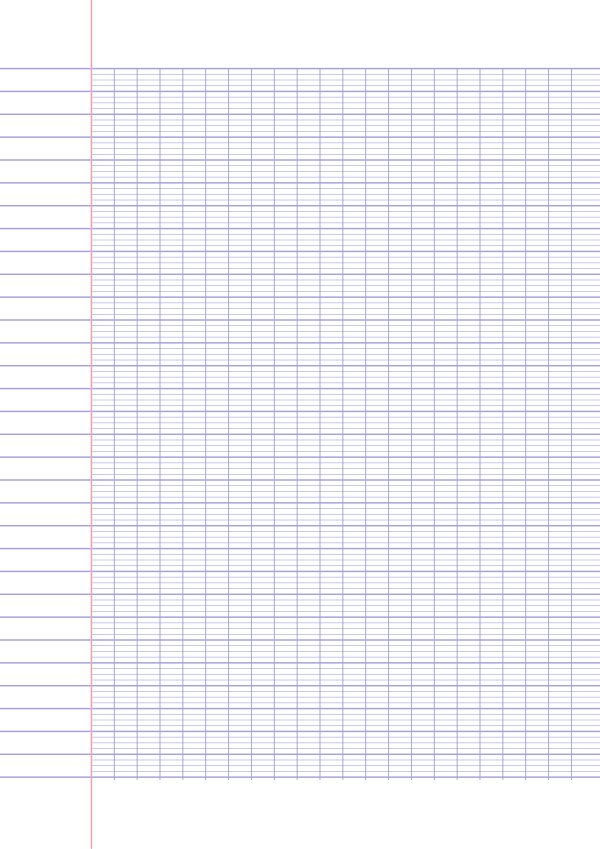
Free A4 PDF of the traditional French ruling — the 8mm "grands carreaux" grid with three 2mm interline guides and a red margin.
Free download
Vector PDF — prints crisp at any resolution. No sign-up, no watermark.
What is Seyès ruling?
Seyès ruling — named after the French stationer Jean-Alexandre Seyès, who patented it in 1892 — is the standard ruling on French notebooks. The page is divided into 8mm squares by heavier horizontal and vertical lines; between each pair of heavy horizontals sit three fine lines at 2mm intervals. A red margin runs 32mm from the left edge.
The 2mm interlines are what make it a handwriting system rather than just a grid: lowercase letter bodies occupy exactly one 2mm interline, ascenders rise two or three, and capitals stand three tall. Writing against these fixed references builds consistent cursive proportions, which is why Seyès remains the reference ruling for cursive handwriting in France.
Anatomy of the page
The heavy horizontal lines run across the margin as well, so a date or number written there sits on the same line as the text beside it. The fine interlines and the vertical lines stop at the margin.
| Element | Measurement | What it does |
|---|---|---|
| Heavy horizontal lines | Every 8mm: 32 lines, forming 31 rows | The writing lines that letters sit on |
| Fine interlines | Three between each pair of heavy lines, 2mm apart | Set the height of each letter zone |
| Vertical lines | Every 8mm to the right of the margin: 21 columns | Keep slant, indents and columns aligned |
| Margin line | Red, 32mm from the left edge | A column for dates, numbers and corrections |
| Grid area | From 24mm below the top edge to 24mm above the bottom | Leaves space for a title at the top |
| Paper and file | A4 (210 × 297mm), purple grid, vector PDF | Prints true to size at 100% scale |
Letter proportions in interlines
French handwriting models measure letters in interlines above the heavy line. The same proportions work for any cursive or print hand you want to make more regular:
- Small letters (a, c, e, i, m, n, o, r, s, u, v, x): one interline, 2mm.
- t and d: two interlines, 4mm.
- Looped tall letters (b, f, h, k, l): three interlines, 6mm.
- Capitals: three interlines, 6mm, the same height as the tall loops.
- Descenders (g, j, p, q, y): below the heavy line into the row beneath; keep them all the same length.
Pen and paper tips
A 2mm x-height is smaller than the lowercase letters most people write on US ruling, so an extra-fine or fine nib keeps loops open. With a medium nib or a gel pen, you can treat two interlines as your x-height instead and scale the other zones to match.
If you write with a fountain pen, print on 90–100 g/m² (24–28 lb) paper: everyday 75–80 g/m² copy paper can feather or show through with wet inks. Let a page dry before you stack the next one on it.
If the purple interlines print too faintly, turn off toner-saving or draft mode in your printer settings, or open the template in the editor and pick a darker line color before exporting your own PDF.
Learning cursive and calligraphy as an adult
If you are learning cursive as an adult, Seyès takes the guesswork out of proportions because every zone has its own line. Start with one interline as the x-height and practice the joins between letters; once the rhythm is regular, write whole words without lifting the pen.
For broad-edge or pointed-pen calligraphy, use the grid at a larger scale: treat two interlines (4mm) as the x-height and use the vertical lines to check that your slant stays consistent. For dedicated slanted guides, the editor also has a Calligraphy pattern with 55° slant lines.
Who else finds it useful
Well beyond France, Seyès paper has a following among calligraphy learners (the interlines enforce consistent x-heights), learners of French who want the authentic French notebook experience, and note-takers who like a grid that guides both line height and letter alignment.
Compared with 8mm A4 lined paper, the line pitch is the same, so a Seyès page holds about as many lines; what you gain is the interlines and the vertical grid. Compared with three-line handwriting practice paper, Seyès is much smaller, 8mm rows against 12.7mm, and gives four guide lines per row instead of three.
Frequently asked questions
What do the small lines on Seyès paper mean?
The three fine lines between each heavy line sit at 2mm intervals and guide letter proportions: lowercase bodies fill one interline, ascenders reach the second or third, and capital letters stand three interlines tall.
What does "grands carreaux" mean?
It is French for "large squares" and refers to the 8mm Seyès grid — as opposed to "petits carreaux", the plain 5mm graph grid also common on French stationery.
How many lines are on a Seyès page?
This template has 32 heavy lines, forming 31 rows of 8mm, each split by three 2mm interlines. To the right of the margin there are 21 columns of 8mm squares.
Is Seyès paper available in US Letter?
The download is A4 only, the size French notebooks use. In the editor you can choose Letter with the Seyès pattern and export your own PDF; the 8mm and 2mm measurements stay the same.
Can I customize Seyès paper online?
Yes — the free generator includes a Seyès mode where you can adjust colors and write directly on the grid in your browser, then print or export a PDF.