Printable Isometric Paper
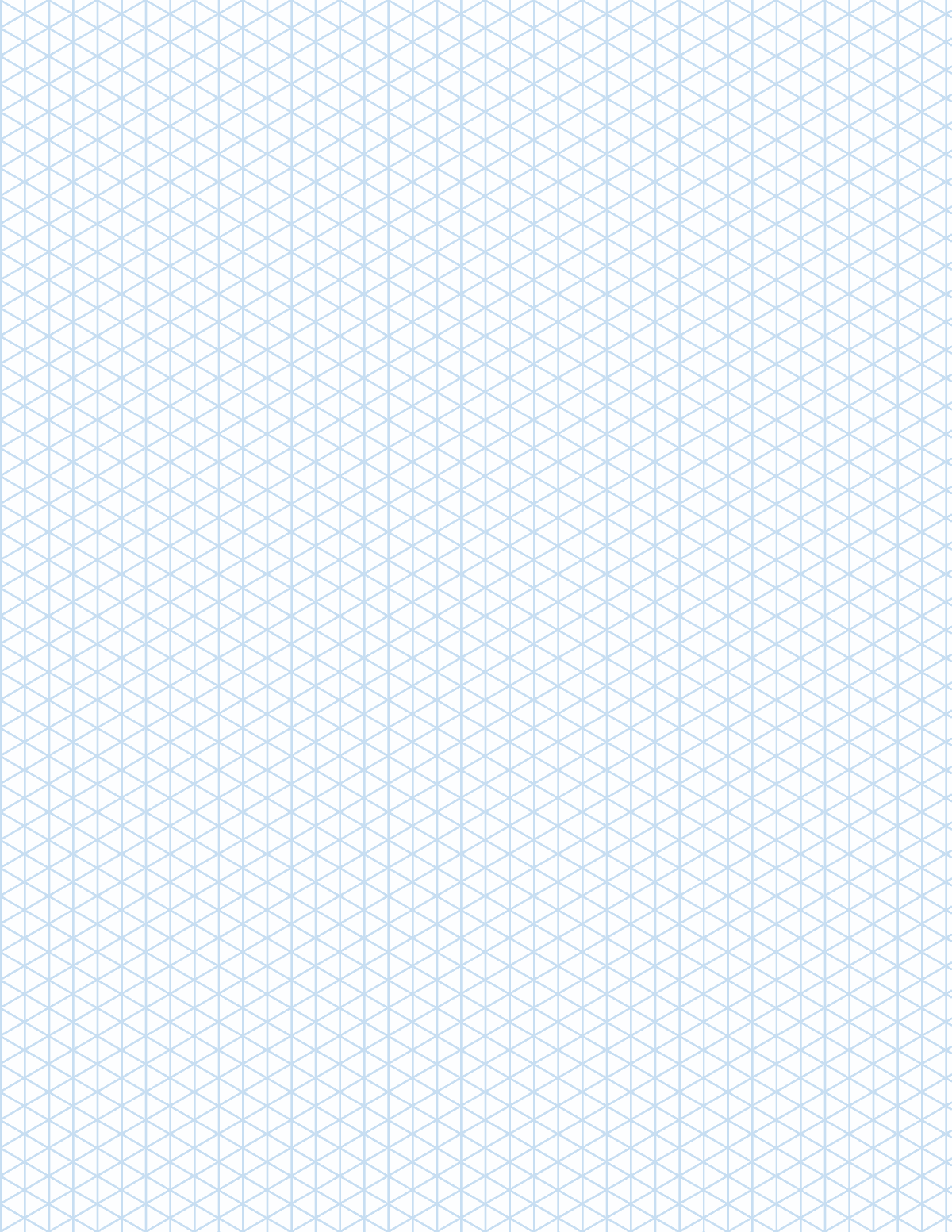
Free PDF download of isometric grid paper: equilateral triangles with 1/4 inch sides on US Letter and 5mm sides on A4, for drawing objects in 3D without a ruler-and-protractor setup.
Free download
Vector PDF — prints crisp at any resolution. No sign-up, no watermark.
More versions to print
The same isometric paper in other paper sizes and line colors, each a free vector PDF. Light gray lines fade into the background so your writing stands out; dark gray ones stay clear on photocopies and on printers low on ink.

Light blue lines · A4Download PDFEdit 
Light gray lines · US LetterDownload PDFEdit 
Light gray lines · A4Download PDFEdit 
Dark gray lines · US LetterDownload PDFEdit 
Dark gray lines · A4Download PDFEdit
What is isometric paper?
Isometric paper is covered with three sets of parallel lines: one vertical, one rising 30° to the right and one rising 30° to the left. Together they form a grid of small equilateral triangles. Each set of lines stands for one direction in space (height, width and depth), so a box drawn along the lines looks three-dimensional straight away.
"Isometric" means "equal measure". All three directions use the same scale, so one triangle side is one unit whether it runs up, to the right or to the left. That is the difference from a perspective drawing, where things shrink with distance: on isometric paper you can count units along any axis and the drawing stays measurable.
Specifications
Both PDFs are drawn at true size, and the grid runs to the edge of the sheet. A home printer leaves a few millimeters blank around the edge, which does not change the size of the triangles.
| US Letter PDF | A4 PDF | |
|---|---|---|
| Paper size | 8.5 × 11 in (215.9 × 279.4mm) | 210 × 297mm (8.3 × 11.7 in) |
| Triangle side | 1/4 in (6.35mm) | 5mm (about 0.2 in) |
| Distance between vertical lines | 5.5mm (about 7/32 in) | 4.33mm |
| Line angles | Vertical, and 30° above and below horizontal | Vertical, and 30° above and below horizontal |
| Line color | Light blue, fine 0.26mm lines | Light blue, fine 0.26mm lines |
| File | Vector PDF, one page | Vector PDF, one page |
What isometric paper is used for
Anything that needs a quick, believable 3D view with real proportions:
- Engineering and product sketches: a part or an assembly drawn in one view, with its dimensions readable along the three axes.
- Piping, ducting and wiring layouts, where runs change direction in three dimensions and a flat plan would hide the vertical sections.
- Architecture and interior design: a room, a piece of furniture or a kitchen layout sketched as a block model before it is drawn properly.
- Game art and maps in the isometric style, where every tile is a diamond made of two triangles.
- Block lettering, optical illusions and impossible shapes such as the Penrose triangle, which rely on the three fixed directions.
- Patterns built from triangles, diamonds and hexagons: quilt blocks, tiling and mosaic layouts, and tessellations.
How to draw a cube on isometric paper
A cube is the basic exercise, because every other isometric drawing is cubes and boxes added together or cut away.
- Pick a grid point near the middle of the page. This will be the front corner of the cube that is nearest to you.
- From that point, draw a vertical line upward, four triangle sides long. This is the front edge.
- From the same point, draw one line four sides long along the grid up and to the right, and one four sides long up and to the left. These are the two bottom edges.
- Draw a vertical line, four sides long, up from the end of each bottom edge.
- Join the tops of the three vertical lines along the grid, then complete the top face with two more lines that meet at the back corner.
Isometric, graph or dot grid paper?
The three are easy to confuse on a shelf, but each one supports a different kind of drawing.
| Paper | Pattern | Best for |
|---|---|---|
| Isometric paper | Equilateral triangles: lines in three directions | 3D views, triangle and hexagon patterns |
| Graph paper | Squares: horizontal and vertical lines | Flat plans, charts, graphs, front and side views |
| Dot grid paper | Dots at the corners of squares | Notes and layouts with a light guide that stays out of the way |
| Hexagonal paper | Hexagons side by side | Chemical structures, game maps, honeycomb patterns |
How to print it
Open the PDF and print at 100% scale ("Actual size"). "Fit to page" shrinks the sheet by a few percent, and the triangles would no longer be exactly 1/4 inch or 5mm. That matters as soon as you draw to scale.
The portrait sheet has vertical lines, which is the usual direction for isometric drawing. If you need a triangle grid with horizontal lines instead, for example for a tiling pattern, simply turn the printed sheet sideways.
Use a sharp pencil or a 0.3 to 0.5mm pen. Sketch lightly first, then go over the visible edges more firmly: the pale blue grid fades behind dark lines, and it almost disappears on a photocopy.
Frequently asked questions
What angle are the lines on isometric paper?
One set of lines is vertical, and the other two are tilted 30° above and below the horizontal. The three sets cross at 60° to one another, which forms equilateral triangles.
How big are the triangles on this isometric paper?
The US Letter PDF has triangles with 1/4 inch (6.35mm) sides, and the A4 PDF has triangles with 5mm sides. Both match the most common sizes of store-bought isometric pads.
Is isometric paper the same as triangle graph paper?
Yes. Isometric paper, isometric grid paper, triangle graph paper and triangular grid paper are different names for the same pattern of equilateral triangles. Isometric dot paper is a variation that prints only the points where the lines cross.
Can I draw circles on isometric paper?
A circle seen at an angle becomes an ellipse. Draw the diamond that the circle would fit in on one face of your object, mark the middle of each side, and sketch an ellipse that touches those four points.
Is an isometric drawing to scale?
Along the three grid directions, yes: every triangle side stands for the same length, so you can count units for height, width and depth. Lines that do not follow the grid, such as a diagonal across a face, are not to scale.
Can I get isometric paper in another color or size?
Yes. Open the free online editor, choose the Isometric background, and change the triangle size, the line color and the paper size before you print or download your own PDF.