How to Draw on Isometric Paper
Isometric paper lets you draw a solid object without perspective rules or a protractor: you count along the grid lines and the three-dimensional shape appears.
Quick answer
Every edge of a box follows one of three directions on the grid: straight up, up to the right at 30°, or up to the left at 30°. Pick a grid point for the nearest corner, count the same number of triangle sides along each direction, and join the ends with lines parallel to the ones you have drawn.
How isometric paper works
The grid is made of small equal triangles. Its lines run in three directions: vertical, and two that slope at 30° above the horizontal, one to each side. These stand for the height, width and depth of an object.
Two things make this easier than perspective drawing. First, all three directions use the same scale, so three units up is as long as three units to the side. Second, lines that are parallel on the object stay parallel on the paper, because nothing shrinks toward a vanishing point. The price is that distant parts look as large as near ones, which is why isometric drawings look slightly flat but are easy to measure.
What you need
- Isometric paper. Print isometric paper with 1/4 inch triangles on US Letter or 5mm triangles on A4. Keep the sheet upright, so one set of lines is vertical.
- A pencil and an eraser. You will draw construction lines and remove them later.
- A fine pen for the final outline, and a ruler if you want crisp edges. The grid is enough for a freehand sketch.
Draw a cube in three steps
- Choose a grid point for the corner of the cube nearest to you. From it, draw one edge straight up, 3 units long. Then draw two more edges from the same point, each 3 units long: one along the line rising to the right, one along the line rising to the left.
- From the far end of each sloping edge, draw a vertical line 3 units up. Join the top of the first edge to the tops of these two verticals. You now have the two side faces.
- Finish the top. From each outer top corner, draw a line parallel to the opposite top edge; the two lines meet at a grid point. Shade the three faces in three tones.
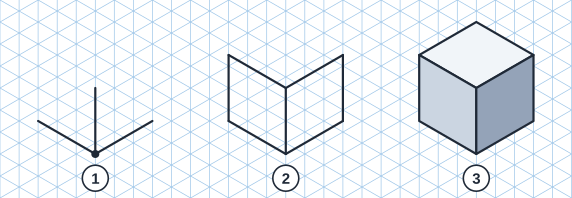
A unit is one side of a grid triangle. If a line you draw does not follow the grid, check your count: on a box, every edge sits exactly on a printed line.
Shade the three faces
Shading is what turns the outline into a solid. Decide where the light comes from and keep it the same for the whole drawing. With light from the upper left, leave the top face lightest, give the left face a middle tone and make the right face darkest. Use the same three tones on every object on the page, so they look as if they stand in the same room.
Draw an L-shaped block
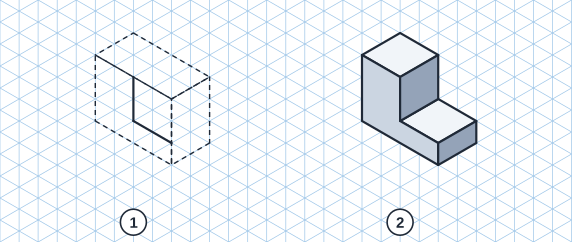
Most objects are not plain boxes, but nearly all of them fit inside one. Draw the box first as a crate, then cut the shape out of it.
- Draw a crate lightly: 4 units long, 2 units deep and 3 units high.
- On the left face of the crate, draw the outline of the L: 1 unit up from the front corner, 2 units back along the top of the low part, then 2 units straight up.
- From every corner of that outline, draw a line 2 units long in the depth direction. All of these lines are parallel.
- Join the far ends with lines parallel to the outline on the left face. Erase the parts of the crate you no longer need, then go over the visible edges in pen.
Circles and cylinders
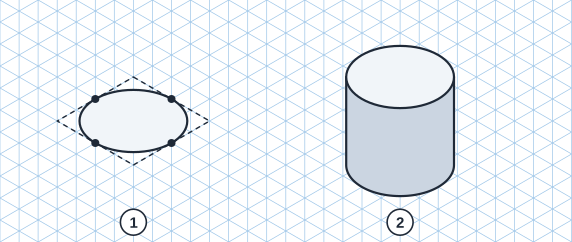
A circle seen at an angle becomes an ellipse. To place it correctly, draw the square that would surround the circle. On isometric paper that square is a diamond. Mark the middle of each of its four sides: the ellipse touches the diamond at exactly these four points and nowhere else. On a top face the ellipse lies flat, with its long axis running left to right.
For a cylinder, draw one ellipse for the top and a second, identical one directly below it at the height you want. Join them with two vertical lines that touch the widest points of the ellipses. Only the front half of the lower ellipse is visible.
Sloping edges
A roof, a ramp or the lid of an open box has edges that follow none of the three directions. Do not try to measure them. Find each end of the sloping edge by counting along the grid, as for any other corner, then join the two ends with a straight line. That line will cross the grid at an odd angle, and that is correct.
Choose a scale
| What you are drawing | On 5mm paper | On 1/4 inch paper |
|---|---|---|
| A small object, such as a phone or a box | 1 unit = 1cm | 1 unit = 1/2 inch |
| Furniture | 1 unit = 10cm | 1 unit = 6 inches |
| A room or a garden | 1 unit = 50cm | 1 unit = 1 foot |
Write the scale on the sheet. Because all three directions share it, you can read any height, width or depth straight off the drawing by counting units.
Isometric, perspective or oblique?
| Method | How it looks | Used for |
|---|---|---|
| Isometric | Parallel lines stay parallel; all three directions share one scale | Technical sketches, assembly instructions, game art |
| Perspective | Lines run toward vanishing points; far parts look smaller | Realistic views of buildings and rooms |
| Oblique | The front face keeps its true shape; depth runs back at an angle, often at half length | Quick sketches of furniture and cabinets |
Common mistakes
- Turning the sheet sideways. With the paper in landscape, no line is vertical and boxes come out tilted. For a wide drawing, make a landscape sheet in the generator, which keeps one set of lines upright.
- Measuring a diagonal with a ruler. Only distances along the three grid directions are to scale.
- Drawing a true circle. A round shape on any face of the object must be an ellipse.
- Changing the light. If the right face is dark on one object and light on the next, the drawing stops looking solid.
- Inking too early. Keep everything in light pencil until the whole shape closes.
Where to go next
Once boxes and cylinders feel easy, combine them: a table is a thin box on four tall ones, and a mug is a cylinder with a handle. To plan a room before drawing it in three dimensions, start with a floor plan on graph paper, then redraw it on isometric paper. For flat tiling patterns and game maps, hexagonal paper is the related grid.
Frequently asked questions
What angle are the lines on isometric paper?
One set of lines is vertical and the other two slope at 30° above the horizontal, one to the left and one to the right. The three directions are 60° apart, and the three axes of a drawn cube meet at 120°.
What size of isometric paper should I use?
Triangles of 5mm or 1/4 inch suit most drawings on a single sheet. Use a larger grid, around 1cm, for a first attempt or for a drawing that will be seen from a distance; the online generator draws isometric paper in any size from 4 to 25mm.
How do I draw a circle on isometric paper?
Draw the diamond that would surround the circle, mark the middle of each of its four sides, and draw an ellipse that touches the diamond at those four points. On a top face the long axis of the ellipse runs left to right.
Is an isometric drawing to scale?
Yes, along the three grid directions. Height, width and depth all use the same scale, so you can measure them by counting units. Diagonals and curves are not to scale.
Can I use isometric paper for pixel art and game maps?
Yes for hand-drawn maps and sketches. Pixel art usually uses a slightly flatter angle, about 26.6°, because lines that rise one pixel for every two across look cleaner on a screen than a true 30° line.